Book Review
Maxwell's Demon
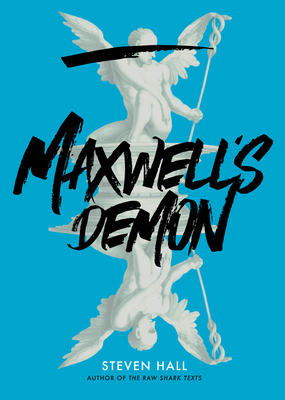
Steven Hall (b. 1975, Derbyshire) published his first novel, The Raw Shark Texts, in 2007: the story of a man hunted by a shark made of words, it became an international bestseller, won the Somerset Maugham Award, and landed its author on Granta’s Best of Young British Novelists list. Then, for fourteen years, nothing. Maxwell’s Demon (2021) is his second novel. It is, among many other things, a book about why certain things take fourteen years.
This is a review of Maxwell’s Demon by Steven Hall.
A review is a machine for sorting. Before the review, there is a pile of books, all jumbled, all at the same temperature. After the review, there are two piles: books you should read and books you should not. The reviewer is the small figure standing at the door between the piles, letting the fast molecules through and turning the slow ones away, apparently producing order from disorder, apparently doing the impossible, for free, on a blog.
(the demon in the thought experiment sorts molecules. the reviewer sorts books. same job, worse pay.)
First, some physics, and I promise to be quick about it. James Clerk Maxwell imagined a tiny demon guarding a tiny door between two chambers of gas. The demon lets fast molecules pass one way and slow molecules pass the other, and so, without expending any energy, makes one side hotter and the other colder: order out of disorder, in open defiance of the second law of thermodynamics. Physicists have spent a century and a half explaining why the demon cannot exist.
Steven Hall has written a novel about a world where it might.
Thomas Quinn is having a hard time. His debut novel, The Qwerty Machinegun, sank without trace years ago, and he now pays his bills writing short stories and audio scripts for other people’s characters, franchise worlds that belong to anyone but him. His wife Imogen is on Easter Island, halfway around the world, running a research project she believes sits next to the most important act in human history, and a webcam feed is not the same as a marriage. The dishes are stacking. The world seems to be hurtling toward what he can only call entropic collapse.
Then Thomas gets a voicemail from his father. His father has been dead for seven years.
The father is Dr Stanley Quinn: poet, journalist, war correspondent, the greatest man of letters of his generation, and a man who always seemed to prefer his enigmatic protégé, Andrew Black, to his own son. Black is the author of Cupid’s Engine, a thousand-page mystery that sold over a million copies and made its author famous despite nobody ever meeting him: no interviews, no photos, nothing. Then Black disappeared entirely. Now, seven years after Stanley’s death, Thomas gets the voicemail, and a letter from Andrew Black containing a single Polaroid of a dark sphere and the question: what do you think this is?
Shortly afterwards, Thomas spots Maurice Umber on a street corner. Maurice Umber is the hero of Cupid’s Engine. Maurice Umber is fictional.
This is a problem.
Here is the thing about the world Thomas lives in, and Hall states it as flatly as a law of nature:
“It’s a hard rule of late-stage capitalism, big, established brands dominate, and start-ups find it harder and harder to get a foothold in the market… This is our age, and it’s the age of the hyperlink and the shared universe, where all the stories are interconnected and everyone takes a turn at being the author of everything.”
Thomas himself is one of those everyone: a man who earns his rent ghost-writing inside other people’s shared universes. Which makes Maxwell’s Demon itself something close to an act of sabotage. It is not a sequel, prequel, remake, or remakquel. It is an original, written by one person, over fourteen years, in an age that has mostly stopped allowing such things. Hold it accordingly.
You get the impression of time passing in a novel. This is a trick, Hall tells us, and then he tells us exactly how the trick works, and then, bastard that he is, he plays it on you anyway, better, because you now know precisely what he is doing and it still works. There is no time in a novel, because entropy does not increase between the first word on the first page and the last word on the last. And yet people in novels age and die, things get lost, worlds unravel, and you feel all of it as though it were happening somewhere. It is happening somewhere: in you, the only place entropy was ever actually increasing.
(that paragraph has been rephrased to avoid misunderstandings. jesus wept.)
A warning, because honesty is the house rule here. The book lectures. It will stop the plot dead to walk you through the second law of thermodynamics (with diagrams), the Gnostic gospels and the Q source, Joseph Campbell’s hero’s journey, the ox and the angel in the nativity, and Andrew Black’s elaborately petty hatred of ebooks. Some pages bend the text into the shape of leaves. If you need your thrillers to stay politely inside their own reality, walk away now. The first hundred pages ask for trust on credit.
Pay it. The last fifty pages collect with interest, pulling rug after rug until the floor itself is gone.
Some lines that stayed with me:
“Entropy is what drives time forwards, and only forwards. It’s the reason you can’t un-stir the milk from your coffee, the reason you can smash but can’t un-smash a glass vase…”
“The only thing necessary for the triumph of chaos is for the repairmen to do nothing.”
“Is the world you live in every day made more from rocks and grass and trees, or from articles, certificates, records, files and letters?”
“Rephrased to avoid misunderstandings. Jesus wept.”
“I felt empty, and utterly powerless as the world unravelled.”
Fourteen years for this book. Read it in 4 days. Carry it longer. Will definitely re-read this book some time in the future.