Book review
Emergency Skin
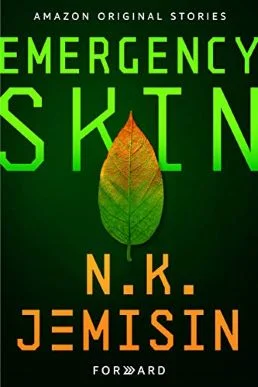
- Author
- N.K. Jemisin
- Published
- 2019
- Genre
- Science Fiction / Novelette
- Pages
- 33
N.K. JEMISIN (Nora Keita Jemisin) was born on September 19, 1972 in Iowa City, Iowa, and grew up between Mobile, Alabama and New York City. She studied psychology at Tulane University and earned a master’s in counseling from the University of Maryland, and for years she worked as a career counselor while writing on the side. You can feel that background in her fiction: her stories watch very closely how systems of power crawl inside people’s heads and convince them to police themselves. Her Broken Earth trilogy made her the first author to win the Hugo Award for Best Novel three years in a row (2016, 2017, 2018), and Emergency Skin (2019), her contribution to Amazon’s Forward collection, went on to win the 2020 Hugo for Best Novelette. She lives and writes in Brooklyn.
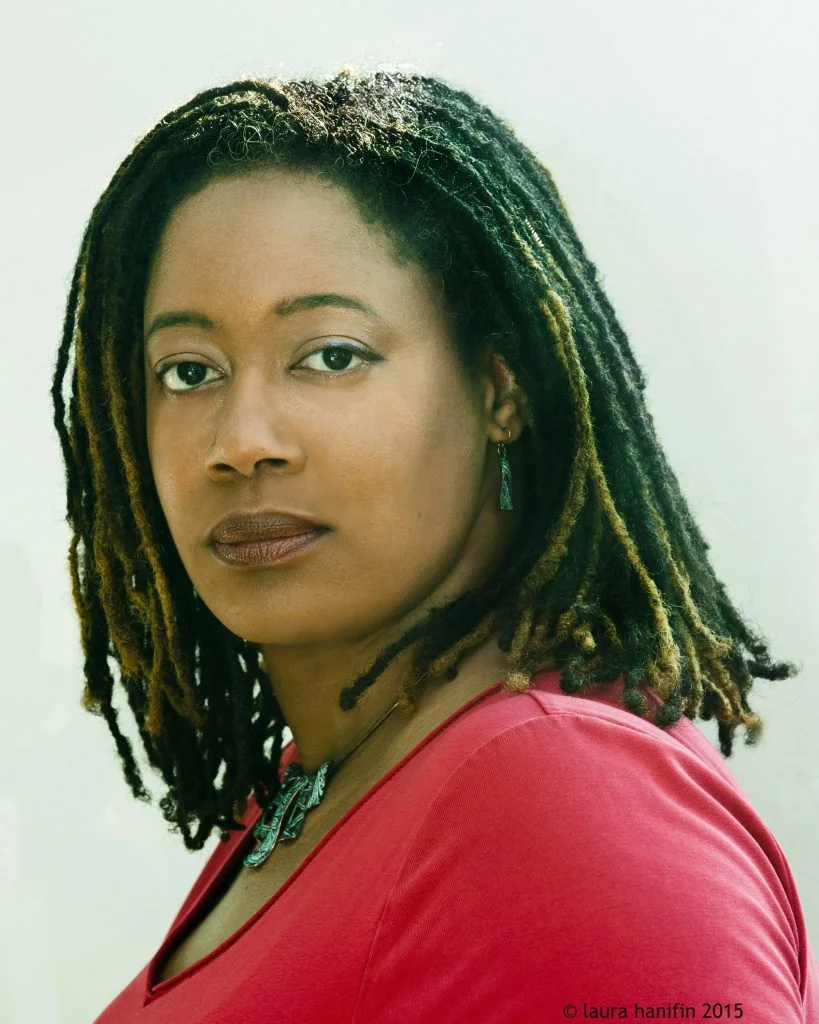 N.K. Jemisin, photo by Laura Hanifin (2015)
I have wanted to get into N.K. Jemisin for a long time now. The problem is that every door into her work is a whole series, with Broken Earth and Inheritance at three books each and Dreamblood at two, and with work eating most of my week, committing to an entire fictional geology felt like signing a lease I couldn’t afford. (my reading list already looks like a debt statement)
So the Forward collection had been sitting in my library collecting dust for a while. Six authors, six stories, one curator. Blake Crouch asked each writer a handful of simple questions about where technology is taking us, and that was more or less the brief. A short story is a commitment I can actually make, so I finally opened it, and I am glad I did, because tucked in there was Jemisin.
The story is told in the second person. You are a colonist from a far off world, sent back to Tellus (Earth) on a mission to retrieve HeLa cell cultures that your society needs to survive. The planet you were raised to believe is a dead, drowned, suffocating ruin. There is a voice in your head, a collective AI made of the Founders, the elite who fled the dying Earth generations ago, and it guides you, corrects you, and reminds you of your place. You don’t have skin. Skin, like beauty, is a reward reserved for those who prove themselves.
“But first, you must earn your beauty.”
I think that line is the whole society in six words. Your body is a wage. You work, you obey, and maybe one day you get to look like a person.
Then you land, and the Earth is not dead at all. It is green and loud and full of people of every shape, size and gender your Founders spent generations teaching you to find disgusting. And the voice in your head starts to sound less like a guide and more like a nervous manager.
I really want to say this is a critique of capitalism and the bourgeoisie. Maybe I am only picking that part because it is the part I always pick (I did write a whole rant on technofeudalism, after all), but I honestly don’t think I’m reaching here. The Founders are the 1% who built an ark for themselves and left billions behind. Their founding principle, rights belong only to those who earn them, is the meritocracy myth with the PR team fired. The fatphobia, the misogyny, the obsession with “efficiency” and “ugly” chaos all come bundled together, because in Jemisin’s world they come from the same place: a small group deciding who deserves to live and calling it order.
And here’s the thing that got me. The twist is not that Earth survived. The twist is why it survived. Once the Founders left, the people who stayed behind dropped the borders, pooled what they had, and fixed it together. The rich leaving was the cure. I won’t spoil more than that, but the moment the story let that land I had to put my phone down for a second.
That’s why I say this doesn’t read like a future we might have. It reads like the one we are being sold right now, by men with rocket hobbies talking about backup planets, while here in Ethiopia the power cuts out on schedule. Jemisin just follows the brochure to the end.
The AI’s excuses were my favorite part to hate. “It isn’t a deception if we didn’t know” is the institutional shrug, the same energy as a bank teller telling you the system is down. Nobody did anything wrong, the knowledge just happened not to be given.
Now, the honest part. There are some places where it falls short for me. The second-person narration is brilliant for the claustrophobia of having a boss living in your skull, but a lot of the big reveal arrives through a guided museum tour, which feels a little like the story stopping to hand you the pamphlet. The people of the new Earth are also almost too gentle, too patient, too sorted out. I wanted to see at least one of them argue. But I also understand that you only get thirty-odd pages, and Jemisin chose to spend them on the voice, which was the right call ig.
What fascinates me most is the craft. From a couple of simple questions in a curator’s brief she built a full political economy, a theology of skin, a history, and a revolution, all in a story you can finish in one sitting. Crouch asks in his note how anyone knows at the moment of discovery where their work will lead. This story feels like an answer from the other side: we already know, we just keep letting the same people decide.
I don’t rate books, but this one did exactly what I needed it to do. It convinced me I can afford the lease. Broken Earth, I’m coming.
Some lines that stayed with me:
“Do you think your ancestors wanted to leave billions of people to starve and suffocate and drown?”
“After all; human beings are better than AI at handling the unexpected. You must simply be prepared for anything.”
“We find such chaos ugly and inefficient.”
“Ugh, look at that one. That morphology is called fat. Fat people are aesthetically displeasing, morally repugnant, and economically useless.”
“Our skin is a mark of honor. Their skin is meaningless.”
“No one lied to you. We weren’t given that knowledge. It isn’t a deception if we didn’t know.”
“It is the guiding principle of our society. Rights belong only to those who earn them.”
“When you complete this mission, for your bravery you will have proven yourself deserving of life, health, beauty, sex, privacy, bodily autonomy, every possible luxury. Only a few can have everything, don’t you see? What these people believe isn’t feasible. They want everything for everyone, and look at where it’s gotten them! Half of them aren’t even men.”
“Now you’re a walking radiation burn, where you should have had ethereal translucence.”
“It would be better to have never been born than to be like this.”
“How does anyone know at the moment of discovery where their work will ultimately lead?” (Blake Crouch, A Note from the Curator)
Words I picked up along the way:
vagaries (noun)
Unpredictable changes or whims in a situation or in someone’s behavior.
Example: No matter how carefully I plan my week, the vagaries of work always find a way to wreck it.
ignominy (noun)
Public shame or disgrace, the kind that sticks to you.
Example: The Founders treat having no skin as an ignominy, a public mark that you haven’t earned your place yet.
anathema (noun)
Something intensely hated or rejected; originally a formal curse or excommunication issued by the church.
Example: To the Founders, the idea of everything for everyone is anathema.