Understanding the Rise of Triple T and What It Means for Society

Tung tung tung sahur. If you have been anywhere near TikTok, YouTube Shorts or a kid with a phone in the last year or so, you already heard that in your head before you finished reading it.
So for the people who somehow missed it, Tung Tung Tung Sahur (or Triple T, which is what I am going to call him for the rest of this blog because I am not typing tung three times every time) is a wooden log with a face who carries a baseball bat. He is part of this whole thing the internet calls Italian brainrot, which is basically a bunch of AI generated creatures with fake Italian sounding names. There is a shark wearing Nike shoes, a crocodile that is also a bomber plane, a ballerina whose head is a cappuccino cup, a chimpanzee inside a banana, and honestly the list just keeps going.
It is really easy to brush this off as kids being kids, you know, the usual “this generation is cooked” stuff, but the more I looked at it the more it started to feel like it was connected to a lot of the stuff I have been reading and writing about on here, especially accelerationism and Nick Land. So me being me, I went down the rabbit hole, and this blog is what came out of it. Fair warning, it gets a bit philosophical in the second half.
(yes i am about to use a tiktok meme to talk about accelerationism. bear with me.)
The origin story is a bit murky but most people agree it started with Tralalero Tralala. According to Know Your Meme, a TikTok user called @eZburger401 uploaded an AI video of a shark wearing Nike shoes in early January 2025, with an Italian text to speech voice reading this rhyme over it. A study in Revista Latina de Comunicación Social puts the date at January 13, 2025 and says that first video alone got around seven million views. The funny part is that if you actually understand Italian, the rhyme is full of blasphemy, and I don’t think most of the people sharing it had any idea.
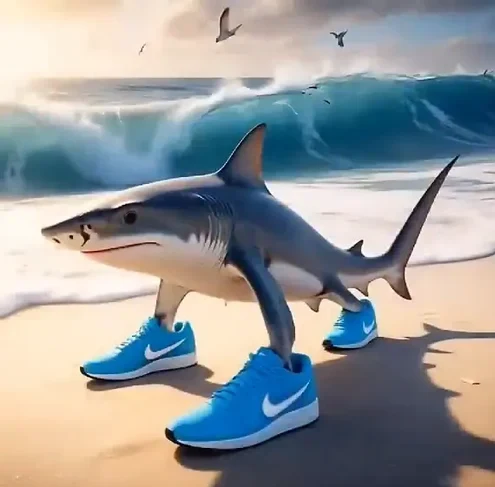
(this is the one that started it all, the shark with the sneakers)
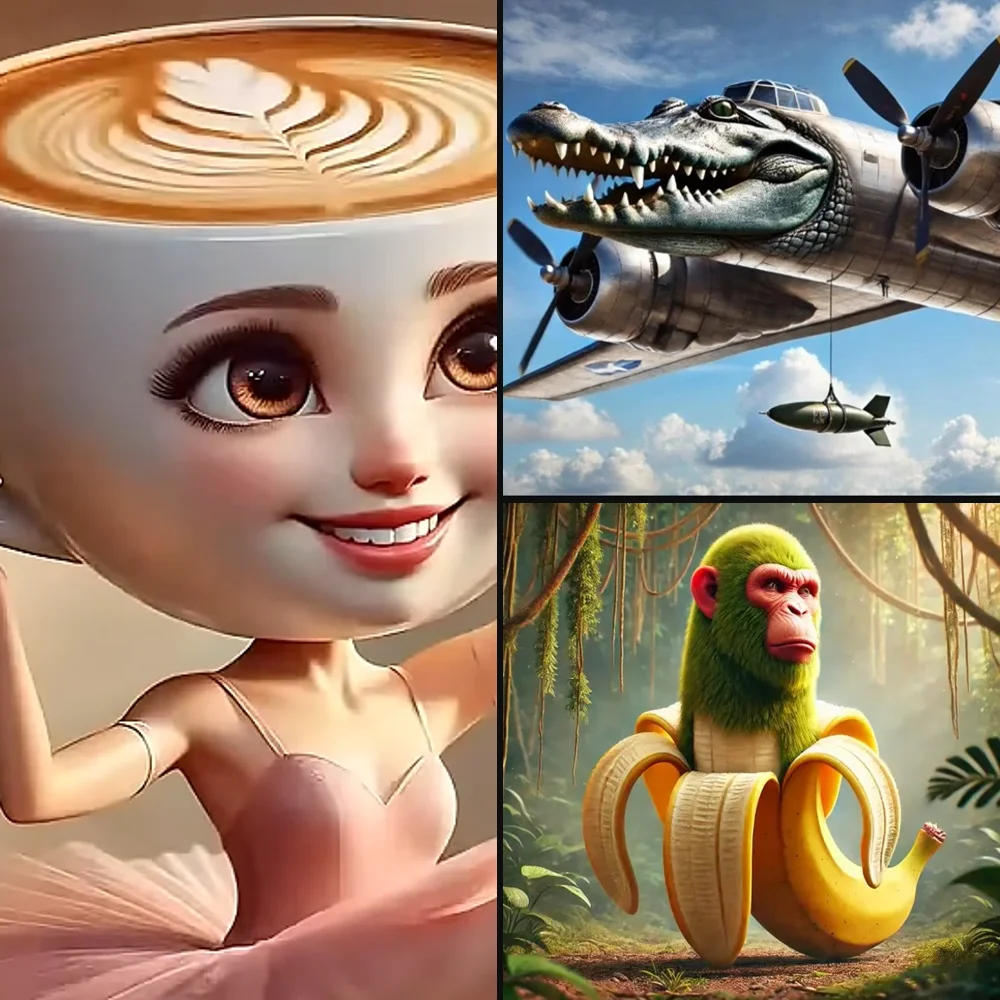
After Tralalero it kind of exploded. Bombardiro Crocodilo came next, then Ballerina Cappuccina, Chimpanzini Bananini, Lirilì Larilà (a cactus elephant, don’t ask) and a lot more after that.
They all follow the same recipe if you look at them closely. You take a weird hybrid image made with AI, you give it a fake Italian name that is fun to yell, and you put a robotic voice reading a rhyme over it. Nobody really owns any of them, anyone can make a new one, and the ones that stick around are just the ones the algorithm decided to keep pushing.
And the numbers on these got kind of ridiculous. The first Chimpanzini Bananini video was posted on March 13, 2025 and got around 29 million views in two weeks. Ballerina Cappuccina got more than 55 million views on TikTok in the first half of 2025, mostly from tweens (kids around 9 to 12), according to the Associated Press. There is also a video an artist made of the characters partying at an underground rave which got about a million views overnight and has since gone past 70 million.
---
config:
  xyChart:
    xAxis:
      labelPadding: 16
    yAxis:
      labelPadding: 16
---
xychart-beta
    title "Views on early brainrot videos (millions)"
    x-axis ["Tralalero", "Chimpanzini", "Ballerina", "The rave"]
    y-axis 0 --> 80
    bar [7, 29, 55, 70]
(these are the numbers that got reported at the time so take them as rough snapshots, view counts only go up anyway)
Now the part I actually find the most interesting is that Triple T is not even Italian, he is Indonesian.
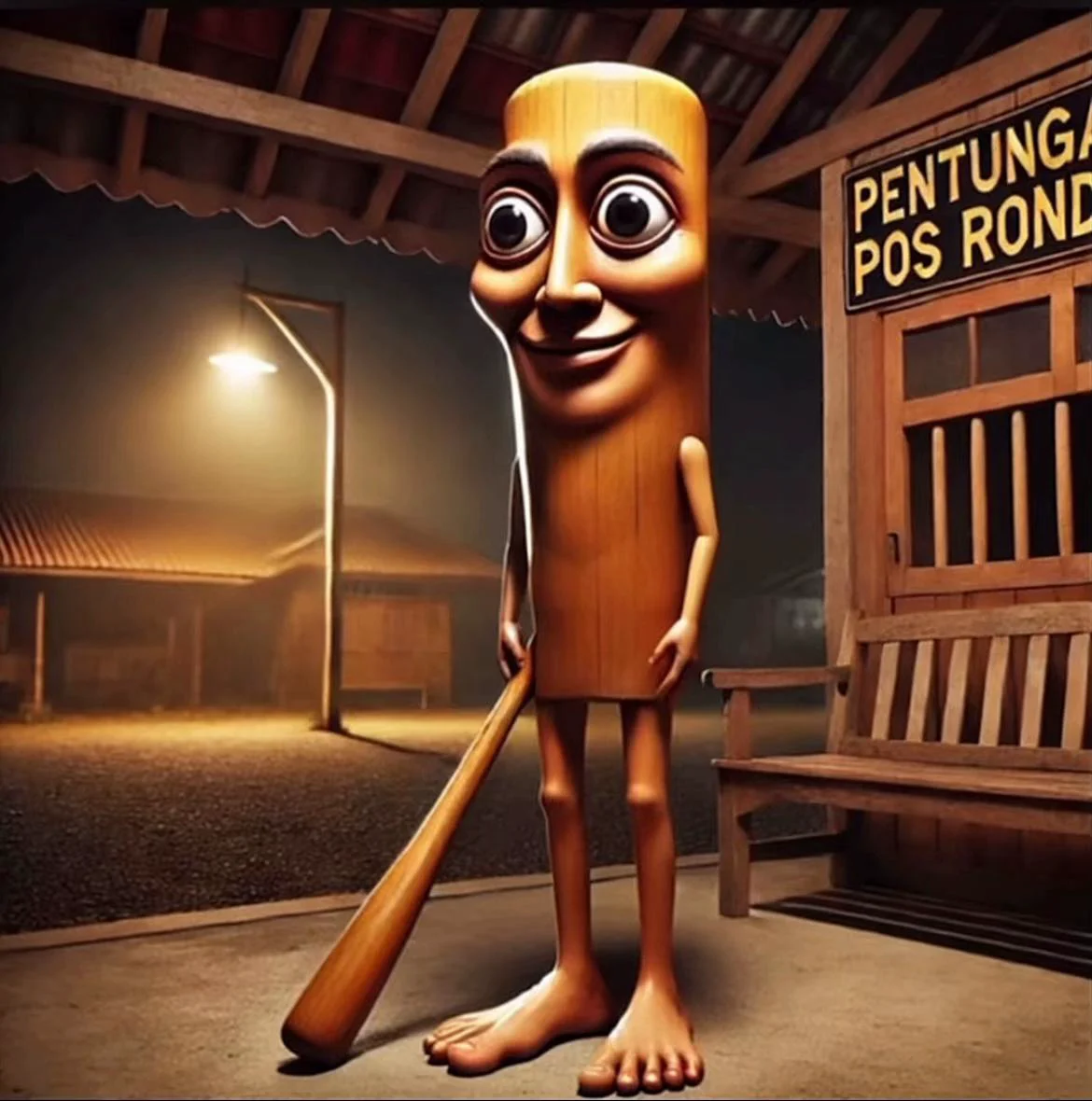
(the man himself, Triple T)
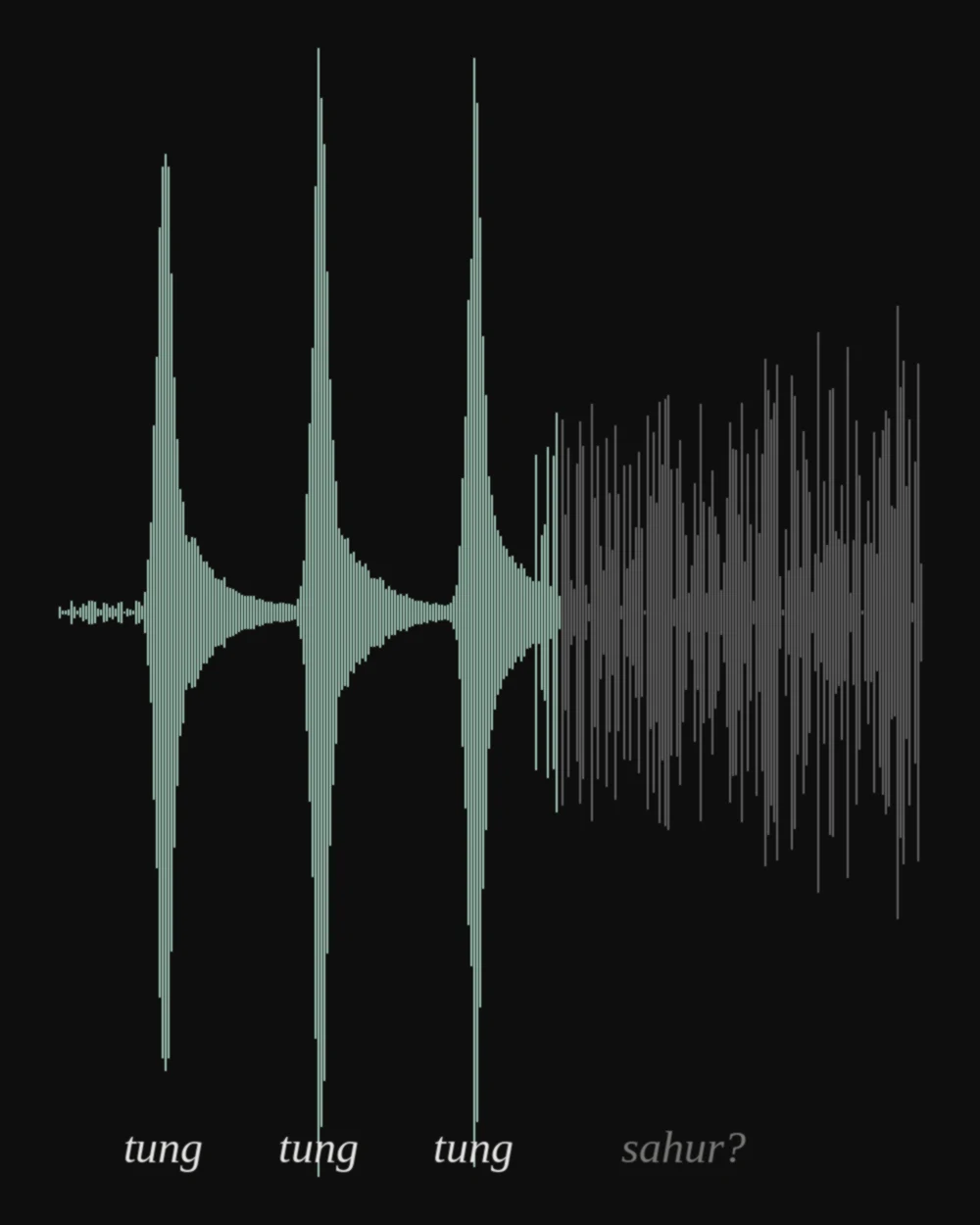
He was posted in late February 2025 by an Indonesian TikTok user called @noxaasht, right around the start of Ramadan. The “tung tung tung” is the sound of the bedug, which is a big drum people beat in the streets before dawn during Ramadan to wake everyone up for sahur, the meal you eat before you start fasting for the day.
The lore that grew around him is basically a kids’ ghost story. If someone calls you for sahur three times and you don’t wake up, Tung Tung Tung Sahur comes for you with his bat.
And most of the people who shared him had no clue about any of this. They didn’t know he was Indonesian or what sahur even meant, they just liked how it sounded and only went looking for the meaning after he blew up.
There is a really good piece on the Algofolk newsletter that calls this sensonarrative power, which is a fancy way of saying the sound and the feel of the thing does all the storytelling and the meaning barely matters. I think that is honestly the key to understanding this whole trend. Italian brainrot isn’t really Italian and it isn’t really about anything, it is just sounds that are fun to repeat stuck on images weird enough to make you stop scrolling. The Italian part was just the costume, and when someone in Indonesia put a different costume on it, it did even better.
If all of this had just stayed on TikTok it would have been a funny little internet moment, but it didn’t stay there.
In May 2025 a Roblox game called Steal a Brainrot came out, made by a group called BRAZILIAN SPYDER. You buy brainrot characters off a conveyor belt and steal them from other players, and kids took it very seriously, the AP mentioned a TikTok of a little kid crying over a stolen brainrot that had over 46 million views. In July the game had about 5 million people playing at the same time, by August it passed 20 million, and in October it hit 25.4 million, which PocketGamer.biz reported as the record for any single game ever. For context, Fortnite’s record was 15.3 million back in 2020. At one point Steal a Brainrot and another Roblox game called Grow a Garden pushed Roblox to 47.4 million people online at once, which is more than Steam’s all time peak of about 41 million.
---
config:
  xyChart:
    xAxis:
      labelPadding: 16
    yAxis:
      labelPadding: 16
---
xychart-beta
    title "Steal a Brainrot, peak players at once, 2025 (millions)"
    x-axis ["Jul", "Aug", "Sep", "Oct"]
    y-axis 0 --> 30
    bar [5, 20, 24, 25.4]
So a shark in sneakers in January turned into the most played game in history by October, which is just insane to me. Bruno Mars even did a concert inside the game in January 2026 and 12.8 million people logged in to watch it. Hungary’s prime minister posted a TikTok with a dancing Triple T in it, Italian newsstands started selling brainrot trading cards, and there are horror games, songs, plushies and a whole fan wiki with lore about who is married to who (apparently Ballerina Cappuccina is married to a ninja called Cappuccino Assassino and cheated on him with Triple T, and no, I did not make that up).
---
config:
  xyChart:
    xAxis:
      labelPadding: 16
    yAxis:
      labelPadding: 16
---
xychart-beta
    title "Record crowds online at once (millions)"
    x-axis ["Fortnite", "Brainrot game", "All of Steam", "All of Roblox"]
    y-axis 0 --> 50
    bar [15.3, 25.4, 41.2, 47.4]
(just so we are clear, fortnite and steal a brainrot are single games while steam and roblox are whole platforms, so one game about meme characters got to more than half of steam’s all time record on its own)
And then it dropped just as fast as it went up. The tracking site RoWatcher now shows Steal a Brainrot at around 200,000 players, which is still a lot of kids but nothing compared to the peak. Keep that shape in mind, the straight line up and then the cliff, because I come back to it later.
This wasn’t only happening on Roblox either. In late 2025 the video editing company Kapwing did this experiment where they made a brand new YouTube account and logged the first 500 Shorts it got shown. 104 of them, which is about 21 percent, were AI generated, and 165, about a third, were brainrot. That is not some weird corner of the internet, that is what a new person gets served by default.
---
config:
  xyChart:
    xAxis:
      labelPadding: 16
    yAxis:
      labelPadding: 16
---
xychart-beta
    title "First 500 Shorts on a new YouTube account (percent)"
    x-axis ["AI-generated", "Brainrot"]
    y-axis 0 --> 40
    bar [21, 33]
Even the dictionaries picked up on it. Oxford made brain rot its word of the year for 2024 because usage of the term went up 230 percent in a year, and the first recorded use is actually from Thoreau’s Walden back in 1854, where he asks why England is trying so hard to cure the potato rot and not the brain rot. Then Merriam-Webster picked slop as its word of the year for 2025, and they now define it as low quality digital content made in quantity with AI. So two years in a row the word of the year was pretty much about this.
Okay so this is where the philosophy comes in.
If you have read some of my older stuff you know I have been on a Nick Land phase for a while. Back in the 90s at the University of Warwick, Land and a group called the Cybernetic Culture Research Unit (the Ccru) came up with this word, hyperstition. Land described it as an “element of effective culture that makes itself real.” In simple terms, a hyperstition is a fiction that becomes true because enough people spread it around and act like it is real. It isn’t exactly a lie and it isn’t exactly a prophecy either, it is more of a loop. The Ccru actually wrote a lot of made up stuff, fake gods and demons and lemurs and so on, partly as an experiment to see if a story could start becoming real if it spread far enough. If you want the longer version, the Wikipedia page on hyperstition is a decent starting point.
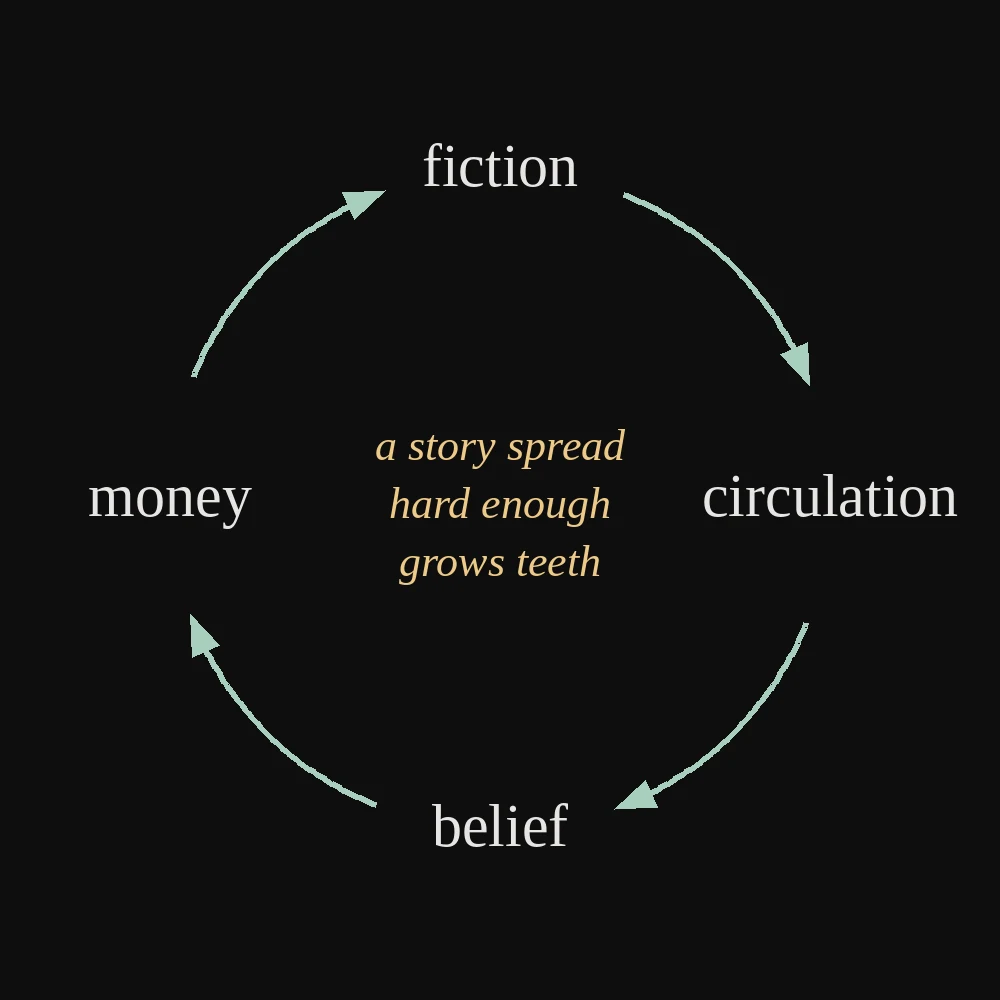
And when you look at Italian brainrot through that lens it fits almost too well. A fake Italian folklore that nobody in particular made kept spreading until it had a lore wiki, marriages and affairs between characters, trading cards at real newsstands, a record breaking game, a Bruno Mars concert and a prime minister dancing next to it.
None of it was true at the start and all of it is true now. The fiction didn’t describe a world, it kind of made one, and it did it in about nine months, which is way faster than anything the Ccru could have pulled off back in the dial up days.
Land also has this bigger and darker idea that I wrote about in Accelerationism and the Circuit of Destiny, which is that capitalism isn’t really something humans are in control of. In his view it is more like a process, almost an intelligence of its own, that builds itself out of our wants and habits and keeps speeding up, and we are less the drivers and more the fuel.
Now think about how one of these brainrot characters actually gets made. An AI image generator makes a picture nobody really designed, a text to speech voice reads a rhyme nobody really wrote, and then the recommendation algorithm decides which of the thousands of versions survives based on one thing, whether kids kept watching. So in a weird way the kids aren’t even the audience, they are more like the test the content has to pass to keep going. The only human part left in the whole thing is the swipe.
And I think that is what slop actually is. It isn’t bad art, because bad art still means someone was trying to say something. Slop is more like what comes out the back of a machine that runs on attention, it is made for the feedback loop and not really for us.
(land would probably think this is great, but land says a lot of things and i am not land)
The part that actually bugs me though is less about the machines and more about us.
Baudrillard has this idea of the simulacrum, which is a copy that doesn’t point back to any original anymore, like a map of a place that doesn’t exist. And honestly Tralalero Tralala might be the best example of it I have ever seen. It isn’t a copy of Italian culture, it isn’t even a copy of a copy, it is just the sound of Italian as imagined by people who have probably never been to Italy, read by software, stuck on a shark wearing shoes. It means nothing, and I think that is exactly why it spread everywhere, because there is nothing in it that gets lost in translation.
The other thing adults keep missing when they panic about this is that the kids know. Nobody under fifteen thinks Triple T is real. They know it is nonsense and they know it is AI, the genre is literally called brainrot, it names itself after the damage. And they still play along with full commitment, making lore and arguing about which characters should date. It is like a shared delusion that everyone is in on, where knowing it is fake doesn’t make it let go of you at all.
Lacan has a seminar called Les non-dupes errent, which roughly means “the non-duped err” and is also a pun on les noms du père. The idea, as far as I understand it, is that the people who think they are too smart to be fooled are usually the most lost, because they confuse being cynical with being free. I think about that whenever I see grown adults making fun of brainrot while doomscrolling forty second clips of podcasts they will never actually listen to. Knowing it is fake was never the thing that protects you, and I think the irony is honestly part of how it gets in.
What worries me the most is that a format where nobody checks the meaning is the perfect format for people who don’t want you checking the meaning. The original Bombardiro Crocodilo audio is widely tied to some really disturbing lines about Gaza (some fans say the rhyme itself is older), and a K-pop idol had to apologise after using it in a video without knowing. And in the same Merriam-Webster announcement about “slop”, they mention the US defense secretary posting an edited image of Franklin the turtle, the kids’ cartoon, holding a grenade to defend US military actions in Venezuela. When nonsense becomes the main genre, people stop asking whether something is true and only ask whether it is fun to repeat, and that is a really good deal for anyone with something ugly to sell.

(this is kind of how i picture the feed, one tile you remember and a thousand blurry ones you don’t)
So what does all of this actually mean for society? I don’t want to end this on pure doom because I don’t fully believe that either.
Kids have always made up nonsense. Every playground has rhymes that don’t mean anything and get passed around without anyone writing them down. A German newspaper, Die Tageszeitung, called Italian brainrot a creative way of playing with technology, language and pop culture, and I think there is something to that. Someone in Indonesia took the drum from their own streets and turned it into a character kids from Rome to São Paulo to Hanoi are yelling at each other, and that is folklore, it is just folklore moving at the speed of a server farm.
The difference I think is who owns the playground. The old rhymes belonged to the kids, but these belong to the platforms and to whoever is farming views off them. Kapwing estimated that the biggest AI slop channels can make millions a year, and RoWatcher calls Steal a Brainrot arguably the most commercially successful Roblox game ever. Whoever made Triple T got their moment of fame and the loop got the money. And that is the accelerationist part that I can’t shake, the machine doesn’t need the culture to be good, it only needs it to be fast and then it needs the next one. That cliff after the peak isn’t a bug, that is just how the whole thing keeps running.
So my honest answer is that I don’t think Italian brainrot is the end of culture, but I also don’t think it is just harmless fun. I see it more as a demo of what happens when making content costs basically nothing, the algorithm is the only judge and we all just kind of agree that meaning is optional. Triple T is the first character from that world that went truly global, he definitely won’t be the last, and I doubt the next ones will all be as harmless as a log with a bat.
What do we do about it then? I don’t think the answer is throwing your phone away or lecturing kids about it, they honestly understand this stuff better than we do. I think it is more about keeping at least one thing in your life that is slow and means something on purpose, like a long book or a proper conversation or a song you actually learned the words to. I went on about this a lot more in The Society of the Chatbot if you want the long version.
The thing I keep coming back to though is the drum. The original tung tung tung was a drum that went around the streets before dawn to wake people up, and somewhere along the way we turned it into the thing that keeps us scrolling half asleep.
Sources
- Know Your Meme, Italian Brainrot / AI Italian Animals
- Olivares-Delgado et al., Italian Brainrot and Generative AI: The Hyper-Engagement of Absurdity on TikTok, Revista Latina de Comunicación Social
- Algofolk, Tung Tung Tung Sahur’s sensonarrative power
- Associated Press via KSAT, Don’t look now, but there’s an AI-generated Italian teacup on your child’s phone
- PocketGamer.biz, Steal a Brainrot becomes first game to surpass 25m concurrent players
- Wikipedia, Steal a Brainrot and Italian brainrot
- RoWatcher, Is the Brainrot Trend Dying?
- Digital Music News, Bruno Mars Roblox concert record
- Kapwing, AI Slop Report: The Global Rise of Low-Quality AI Videos
- Oxford University Press, Brain rot named Oxford Word of the Year 2024
- Associated Press via WAFF, Merriam-Webster’s 2025 word of the year is slop
- Wikipedia, Hyperstition