Manga Review
I still think about opus
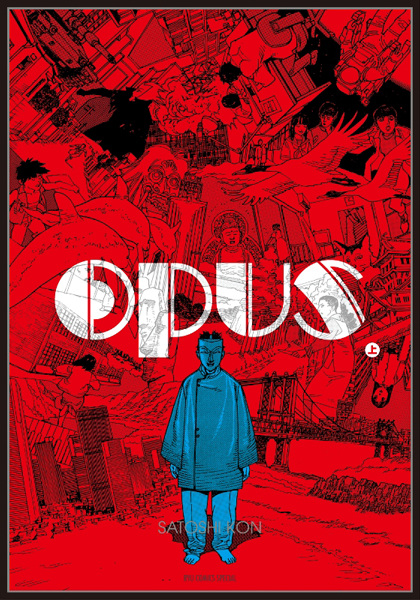
Light spoilers ahead beware.
Satoshi Kon is a name that carries a certain weight, a quiet reverence among those who have seen Perfect Blue or felt reality shatter after watching Paprika. We remember him for the seamless dissolves between dreams and waking life, for the way he fractured the fourth wall before it was even a wall. But before he was the master of cinematic anime, he was a mangaka struggling to finish his debut, a series that would be abruptly canceled, its plates lost to time, only to resurface years after his untimely death in 2010.
That series is Opus, and reading it feels less like opening a comic and more like stepping into a room where the architect is still actively rearranging the furniture while you’re sitting in it.

The premise is deceptively simple: Chikara Nagai, a manga artist, is drawing a gritty crime thriller called Resonance. Frustrated with the story’s direction and unable to kill off his protagonist, he enters his own manga through a magical pen. But the fiction he enters is collapsing. Characters are becoming aware of their creator, villains are escaping into the “real” world, and the boundaries between Nagai’s studio and the black-and-white panels of Resonance begin to bleed into one another.
Kon wastes no time establishing his signature play with perception. The transition from reality to fiction isn’t a portal or a dream sequence; it’s a dissolve. One moment Nagai is holding his pen, the next he is the subject of the very lines he drew. The art style shifts subtly but distinctly as characters cross these thresholds, a technique Kon would later perfect in his films.
I won’t try to summarize the entire descent into madness, because the joy of Opus is in the unraveling. What starts as a meta-fictional gimmick quickly evolves into a profound meditation on the relationship between a creator and their creation. Nagai is confronted by his own tropes: the damsels he objectified, the villains he cartoonishly evil’d, the plot holes he hoped no one would notice. It is a rare moment of an author putting himself on the stand.
There’s a sequence early on where a character from Resonance crosses into Nagai’s world, and the sheer horror of a two-dimensional sketch navigating a three-dimensional space is handled with a mixture of comedy and existential dread. It reminds me of the way Paprika (2006) and how it treats the parade.
What makes Opus linger is its incompleteness. The series was canceled in 1996 after just 20 chapters, leaving the story suspended in a climax that was never resolved. In his afterword to the recovered edition, Kon wrote about the frustration of that cancellation,( i am also frustrated man) how he felt he was just getting started. There is a tragic irony in reading a story about a creator trapped inside his own unfinished work, written by a creator who would leave his own greatest works unfinished by his death at 46.
Yet, even in its fragmented state, Opus stands as a complete artistic statement. It is the Rosetta Stone for understanding everything Kon would go on to do. You see the DNA of Millennium Actress in the way timelines merge; you see the paranoia of Perfect Blue in the way identity is questioned; you see the dream-logic of Paprika in the collapse of physical laws.
Reading Opus is like finding a sketchbook where an architect has drawn the blueprints for buildings he would only construct years later, knowing he wouldn’t live to see them all finished. As heart breaking that is, there is also something beautiful about it.
It’s messy, it’s frantic, and sometimes the meta-narrative knots itself up so tightly you have to pause. But it’s also alive in a way that few manga are. It breathes with the frantic energy of a young artist who knows he has something to say but is still figuring out the vocabulary.
I still think about Opus because it asks the question every creator fears: What happens when the work outlives the worker? What happens when the fiction becomes more real than the fact? Kon didn’t just write a manga about a manga; he wrote a eulogy for the creative process itself. And I shall glaze him to the end of my days.
Somethings that caught my eyes
“The moment you give a character a name, they stop being yours. They belong to the reader.”
“I drew the pen to escape the story, but the story was already inside the pen.”
“Reality is just another layer of ink.”